
The PM–Architect Relationship: Delivery Meets Reality
Project success is often decided in the space between urgency and feasibility. Explore how Project Managers and Architects balance delivery expectations, technical constraints, and the decisions that shape project outcomes.
If the relationship between the Project Manager and Architect had a soundtrack, it would probably sound something like this.
“When will this be finished?”
“Well… it depends.”
“On what?”
“It depends.”
One person wants certainty. The other wants context. And somewhere in the middle sits delivery.
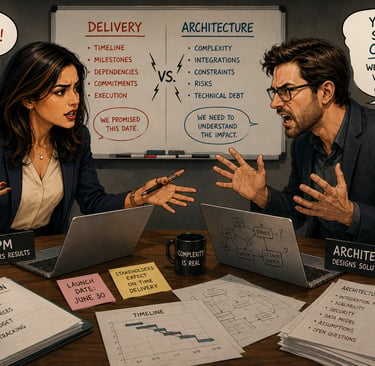
Among all the relationships inside project teams, the PM–Architect dynamic might be one of the most misunderstood. On the surface, it can look adversarial. The Project Manager keeps asking for dates, decisions, and commitments. The Architect keeps asking questions, identifying dependencies, introducing constraints, and responding with phrases that make timelines uncomfortable. From the outside, it can feel like they are working against each other.
But they are not. They are solving for different types of failure.
The Project Manager exists to reduce delivery uncertainty. Their responsibility is to create enough structure and momentum that work continues moving forward. Projects cannot operate indefinitely inside discovery. Teams need decisions. Stakeholders need expectations. Dependencies need dates. At some point, ambiguity must become execution.
Architects exist to reduce solution uncertainty. Their responsibility is to slow down assumptions long enough to understand consequences. Every decision carries tradeoffs. Every shortcut creates future maintenance. Every compressed timeline introduces technical risk somewhere. Architects are not asking questions because they enjoy complexity. They are trying to prevent teams from committing to a future they do not yet understand.
That difference in perspective creates tension.
The PM hears, “We need more detail,” and translates it as, “We are blocked.” The Architect hears, “We need a commitment,” and translates it as, “We are making decisions too early.”
Neither interpretation is completely wrong. But left unmanaged, this tension creates unhealthy delivery patterns.
One of the most common places this relationship begins to fracture is around deadlines.
An executive sponsor announces a launch target. Funding approvals assume a delivery window. The business publicly commits to timing expectations. By the time the project team receives the information, the date no longer feels like an input. It feels like a promise.
The Project Manager inherits that commitment whether they created it or not. Their responsibility becomes creating enough structure, accountability, and momentum to give the team the best chance of succeeding within those constraints. They establish milestones, ask for estimates, sequence dependencies, and begin pushing toward execution. Status meetings become increasingly focused on timelines because that is the language the organization is speaking.
The Architect experiences the same situation very differently.
From their perspective, the project may still be operating inside uncertainty while the organization is behaving as though certainty already exists. Requirements may still be changing. Integration patterns may not be validated. Security review may not be complete. Data assumptions may still be untested. The Architect is not resisting delivery. They are reacting to the uncomfortable feeling that execution has started before understanding has caught up.
This is usually where frustration becomes visible.
The Project Manager sees hesitation and interprets it as lack of commitment. The Architect sees commitment and interprets it as premature certainty. Meetings become increasingly tense because both sides believe they are protecting the project.
The strongest PM–Architect partnerships eventually shift the conversation.
Instead of asking, “Can we make this date?", they ask, “What would need to become true for this date to be realistic?”
That question changes everything.
I saw another version of this dynamic play out firsthand on one of the projects I inherited.
The project had a fairly mature change request process on paper. Business stakeholders submitted requests, impacts were discussed, approvals moved through governance channels, and executive sponsors ultimately decided what entered scope. From an operational perspective, everything looked healthy. The team had process, structure, and decision-making mechanisms in place.
What nobody realized at first was that the process had a blind spot. Architect review was never built into change approval.
As a result, change requests were evaluated primarily through business value, urgency, and delivery timing. If leadership approved the request and funding existed, the assumption became that implementation could proceed. Scope was updated. Plans shifted. Expectations were communicated.
Then the team got into solutioning. And suddenly what looked like a straightforward enhancement became something entirely different.
A request that appeared small introduced integration impacts. Existing design assumptions no longer held. Additional systems became involved. Data considerations emerged. The implementation path became far more complex than the original conversations suggested.
From the PM perspective, this was frustrating because approval had already happened. From the Architect perspective, it felt backwards.
The question of whether we should do the work had been answered before anyone evaluated what doing the work actually meant.
That experience changed how I approach governance.
Now, on every project I lead, architectural participation is intentionally built into the change process from the beginning. Not because architects should own scope. Or because they're the gatekeepers. But because feasibility is part of understanding impact.
When a change enters evaluation, I want technical understanding present before commitments are made.
How long would this realistically take?
What systems are affected?
What technical constraints exist?
What assumptions are we making?
What would increase confidence?
Those questions do not slow delivery. They protect delivery.
What I found after introducing architecture into change discussions was that the relationship between the PM and Architect started changing.
The conversations stopped becoming negotiations and started becoming problem solving.
Instead of the PM arriving with an approved request and asking the Architect how quickly it could be delivered, both roles began evaluating the request together before commitments existed. The PM brought context around business value, timelines, stakeholder expectations, and delivery impact. The Architect brought feasibility, constraints, technical dependencies, and confidence levels. Decisions became better because neither perspective was operating in isolation.
That experience made me realize something.
The PM–Architect relationship is one that has to stay intentionally aligned because each role creates risk when disconnected from the other. A PM without architectural partnership can create commitments that delivery cannot realistically support. An Architect without delivery partnership can continue exploring long after decisions need to be made.
Neither outcome creates successful delivery. Projects need someone asking whether we can make the date. Projects also need someone asking whether we should commit to the date at all.
The strongest teams do not treat those questions as competing priorities. They treat them as part of the same conversation. Because Project Managers and Architects are not responsible for different outcomes. They are responsible for the same outcome. One protects the ability to deliver. The other protects what ultimately gets delivered.
And when those two perspectives stay aligned, projects stop becoming exercises in managing surprises and start becoming exercises in making intentional decisions.


When the Deadline Exists Before the Plan
When Approval Happens Before Understanding
Stay in the Loop
Occasional thoughts on project leadership, Salesforce implementations, books, and the people side of tech.