
The Holy Trinity of Successful Projects
Successful projects are rarely the result of better methodology alone. They emerge from alignment between three roles at the center of delivery: the Project Manager, Business Analyst, and Architect. In this introduction to The Holy Trinity of Successful Projects series, we explore why these relationships shape outcomes more than most frameworks ever will.
When people talk about successful projects, the conversation usually begins with process. Teams debate Agile versus waterfall. Leaders invest in governance models, delivery frameworks, estimation approaches, reporting structures, and tooling. Entire organizations are redesigned around the hope that better process will create better outcomes. Yet after more than a decade working across implementations, transformations, and delivery teams, I have started to believe that process is rarely the deciding factor. Methodology matters, but relationships determine whether projects actually move.
Over time, I started noticing a pattern. Some projects operated in objectively difficult conditions. Timelines were aggressive. Requirements changed. Teams had competing priorities and incomplete information. And yet those projects somehow remained stable. Decisions happened before problems became emergencies. Risks surfaced early. Delivery teams adapted instead of reacting. The more I looked for the common denominator, the more I realized it was rarely the process itself. It was the relationship between three roles sitting at the center of delivery.
The Project Manager. The Business Analyst. The Architect.
I think of them as the Holy Trinity of successful projects.
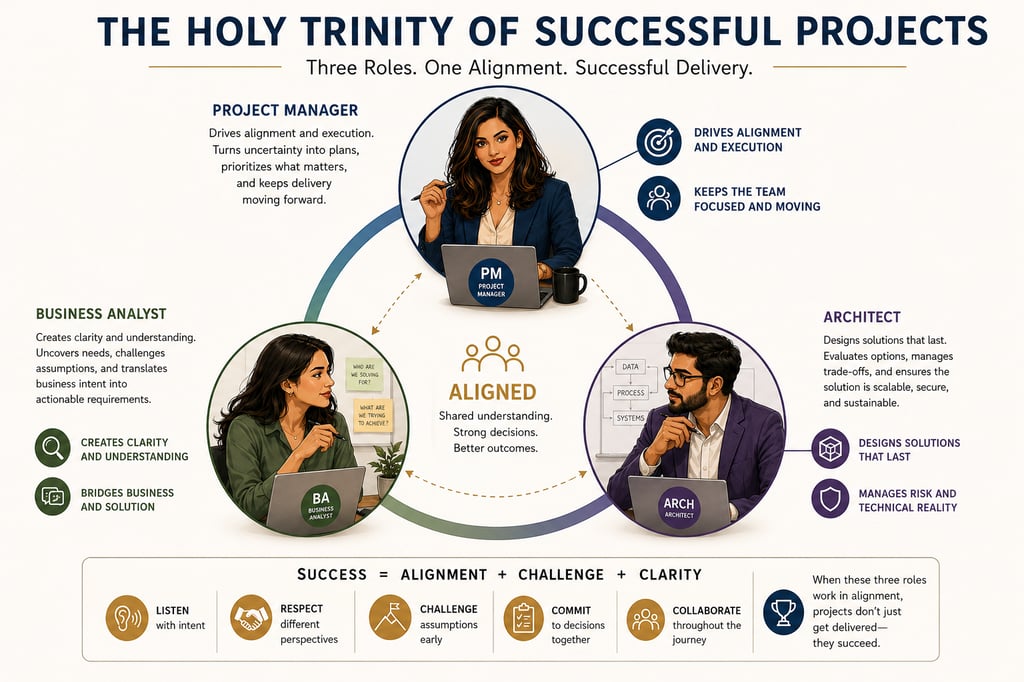

Not because these are the only roles that matter. Delivery depends on developers, quality engineers, product owners, administrators, change leaders, operations teams, executives, and business stakeholders. Great outcomes are always collective. But these three roles occupy something unique. Together, they are responsible for turning an idea into a reality. They sit in the spaces between ambition and execution and spend most of their time translating from one world into another.
The Project Manager translates uncertainty into coordinated action. Their responsibility is not simply keeping a schedule updated or running status meetings. Strong project management creates enough structure that teams can continue moving forward even when not every answer exists yet. A good PM understands how decisions ripple across workstreams, where risks are beginning to accumulate, and when alignment is becoming more important than speed. They create momentum, but they also create enough pause for teams to make intentional choices.
The Business Analyst translates intent into understanding. Requirements documents are often treated as the primary output of business analysis, but documentation is only the visible artifact of deeper work. The strongest BAs are constantly uncovering assumptions, reconciling conflicting expectations, and helping teams articulate what success actually means. They reduce ambiguity before it becomes expensive and create shared understanding between people who may be using the same words but imagining entirely different outcomes.
The Architect translates possibilities into sustainable solutions. While architecture is often associated with technical decisions and solution design, the role extends much further than technology selection or system diagrams. Architects help teams understand tradeoffs. They think about scalability, maintainability, operational complexity, and the long-term consequences of decisions made under short-term pressure. Their role is not to slow teams down. It is to ensure that delivery today does not quietly create limitations tomorrow.
Individually, each of these roles creates value. Together, they create balance.
Without the Project Manager, teams can become thoughtful but directionless. Decisions stay open too long and progress slows under the weight of uncertainty. Without the Business Analyst, teams can move quickly while solving the wrong problem. Assumptions go unchallenged and clarity arrives only after development has already begun. Without the Architect, teams may achieve rapid progress at the expense of sustainability and discover months later that speed created complexity they now have to maintain.
What makes this relationship especially interesting is that these roles are not meant to agree all the time. In fact, healthy delivery often depends on productive tension. The PM pushes for movement because timelines matter. The BA pushes for clarity because understanding matters. The Architect pushes for sustainability because decisions have consequences. None of those priorities are inherently more important than the others. The strongest teams learn how to let those perspectives challenge each other without becoming obstacles.
The projects that stay with me are rarely the ones that executed perfectly. They are the ones where difficult conversations happened early enough to matter. Someone challenged an assumption before it became a requirement. Someone questioned feasibility before development began. Someone slowed the team down just enough to prevent months of rework later. Those moments rarely happen by accident. They happen because the right relationships exist inside delivery.
This observation stayed with me long after individual projects ended.
Across industries, platforms, methodologies, and organizational structures, I kept seeing variations of the same dynamic. The names of the roles sometimes changed. Responsibilities shifted. Team structures evolved. But the need remained the same. Someone needed to drive execution. Someone needed to create understanding. Someone needed to protect the integrity of the solution.
So over the next few articles, I want to explore each relationship inside this triad more intentionally. We will look at where alignment creates momentum, where tension creates stronger decisions, and where misunderstandings quietly introduce project drift. Because while successful projects often look effortless from the outside, the reality is that they are usually built through countless conversations between people translating different versions of the same goal.
And eventually, we will put that theory into practice.
Because a Project Manager, Business Analyst, and Architect walk into a complex implementation.
Stay in the Loop
Occasional thoughts on project leadership, Salesforce implementations, books, and the people side of tech.