
Decisions Don’t Manage Themselves: How Project Managers Track Decisions Before Timelines Pay the Price
Projects rarely fail because leaders avoid making decisions. More often, they fail because nobody can see what decisions matter, who owns them, and what delivery is waiting. A practical look at how Project Managers turn decisions into visible delivery dependencies.


I started maintaining a decision tracker alongside the RAID log and is reviewed in every leadership update.




Previously in Lessons From the Field:
The Quiet Cost of Unmade Decisions
Decisions do not stay unmade forever. Eventually the absence of a decisions becomes the decision.
My Decision Log
Recently, I wrote about The Quiet Cost of Unmade Decisions and the reality that decisions do not stay unmade forever. Eventually, the absence of a decision becomes the decision. Teams adapt. Work reorganizes. Timelines absorb uncertainty whether leadership intends for it to or not.
But that raises the next question.
If unmade decisions are one of the biggest hidden risks in delivery, how do Project Managers actually track decisions in a way that matters?
Not just documenting that a decision exists. Not just keeping a running decision log buried in project artifacts. But making decisions visible in a way executive sponsors and leadership teams can act on.
Over time, I realized most leadership teams do not struggle because they refuse to decide. They struggle because they cannot always see the relationship between a pending decision and delivery outcomes. Project plans usually show activities. RAID logs show risks. Status reports show progress. But very few artifacts clearly show what decision is needed, what work is waiting for it, and what timeline consequence exists if it remains open.
That changed how I started managing projects. I stopped tracking decisions as documentation.
I started tracking decisions as delivery dependencies.
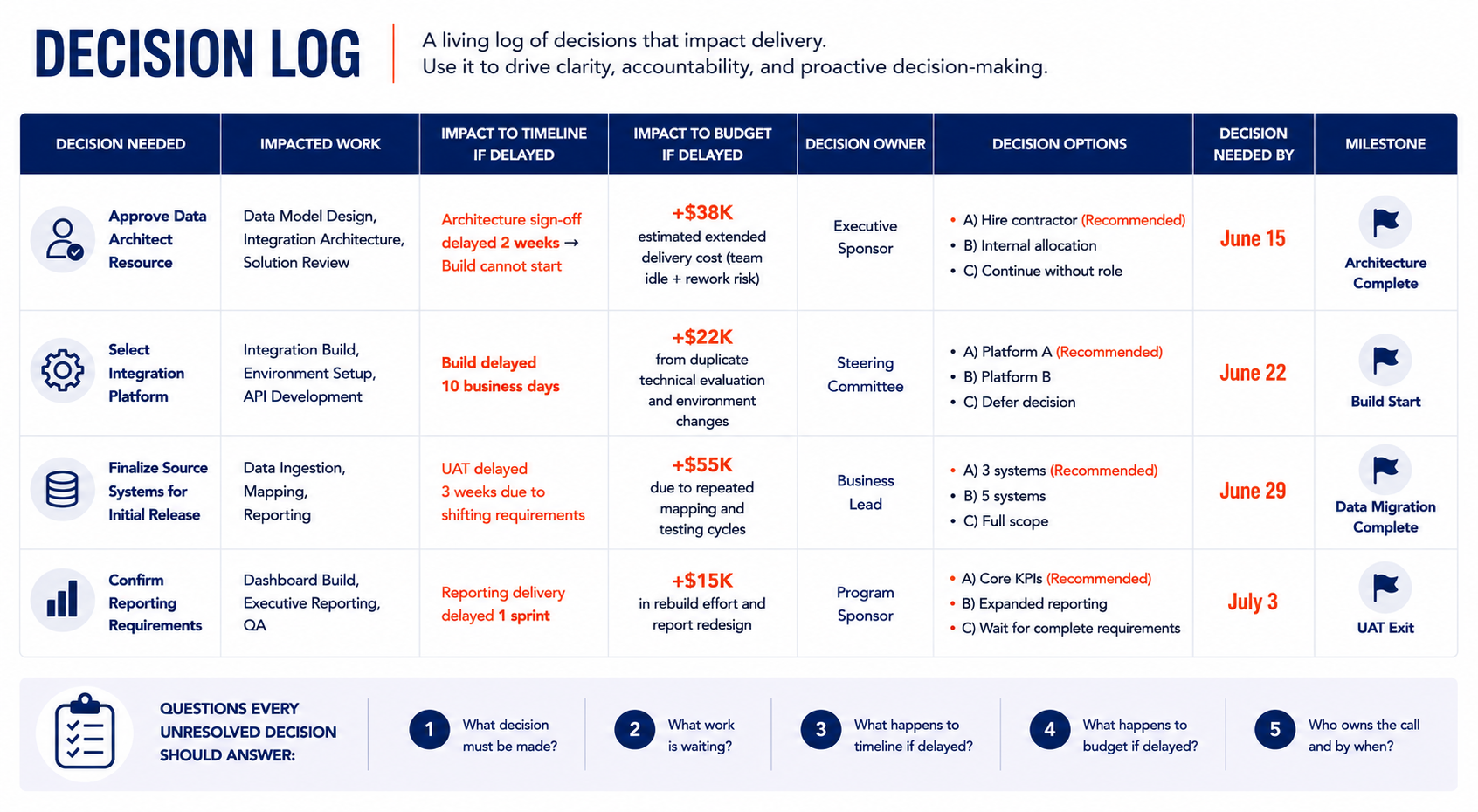
Reading the Decision Log
At first glance, this probably looks like another project tracker. Another table. Another status artifact that gets updated for a few weeks and then quietly disappears into a project folder. That was my assumption for a long time too. But eventually I realized the value of a decision log is not in documenting decisions after they happen. Its value is making unresolved decisions visible before they become visible in the schedule.
Traditional project reporting is usually backward-looking. It tells leadership what completed, what slipped, what risks exist, and where teams stand today. A decision log does something different. It shows what work is waiting and what outcomes become more likely if nobody acts. Instead of reporting status, it exposes dependency.
What surprised me over time is that projects rarely stop moving when decisions are delayed. Teams adapt. Engineers sequence work differently. Business teams postpone sign-offs. Assumptions remain open while delivery continues around them. From the outside everything can still appear healthy, but underneath the plan slowly reorganizes itself around uncertainty.
That realization changed the way I started communicating with sponsors and leadership teams. I stopped bringing abstract statements like “we still need alignment” or “we need additional discussion.” Instead, I started showing what decision remained open, what work was blocked, how the timeline moved if nothing happened, and when the decision stopped being useful. Conversations became more concrete almost immediately.
The goal of this log is not to force decisions or pressure leadership into acting quickly. It is to make the cost of waiting visible enough that decisions become intentional instead of accidental. Every row should answer the same question: what work is waiting because this decision has not happened yet? Once leaders can see that relationship, decision-making becomes significantly easier.


Milestone
Connect to a milestone leaders already care about.
How to Read Each Column
Each field in the decision tracker exists to answer a different leadership question.


Impact to Budget
Quantify the cost of delay when possible. Money drives urgency.










Impact to Timeline
Translate indecision into dates. Make the delay visible.
Deadline Needed By
This is the expiration date for usefulness. Every decision has one.
Decision Options
Bring options and recommendations. Help leaders choose.
Decision Needed
Describe the actual call someone is being asked to make. Be specific.
Impacted Work
Show what cannot move until decision is made.
Decision Owner
Someone owns the call. Participation is not ownership.


Five Questions Every Decision Should Answer










What decision must be made?
What work is waiting?
What happens to timeline if delayed?
What happens to budget if delayed?
Who owns the call and by when?
Final Thought
Projects do not pause while people think. The work keeps moving. The timeline keeps progressing. And eventually the schedule reflects decisions nobody realized had already been made. The role of the PM is not to force decisions. It is to make sure the cost of delaying one becomes impossible to ignore.
Stay in the Loop
Occasional thoughts on project leadership, Salesforce implementations, books, and the people side of tech.