
What The AI-Driven Leader Gets Right About AI, Leadership, and the Future of Work
A review of The AI-Driven Leader by Geoff Woods and why AI is not replacing leaders. Thoughts on adaptation, bias, and the future of work.
Most of us already have opinions on AI.
Some people think it is the scourge of the earth and believe it is accelerating misinformation, eliminating jobs, and making us more dependent on technology. Others are fully embracing it and using it for everything from meal planning to writing code. Some people are quietly experimenting and trying to understand where it fits into their work. Others feel overwhelmed and are wondering whether they are already falling behind.
Either way, the truth is difficult to ignore.
AI is everywhere now.
It shows up in our search engines, our phones, our project tools, our dashboards, our inboxes, and increasingly, our decisions. Whether we actively choose to engage with it or not, AI has already changed the world around us. And if history tells us anything, it is that technological change rarely asks permission before becoming part of everyday life.
That reality creates an uncomfortable question.
What happens next?
Do we resist it? Do we blindly trust it? Do we hand over our thinking? Or do we learn how to work alongside it?
That question is what pulled me into The AI-Driven Leader by Geoff Woods.
Because unlike most conversations around AI, which seem to focus on either fear or productivity, this book explores something more interesting. It asks what leadership looks like when intelligence is no longer exclusively human. And surprisingly, the answer is not becoming more technical. It is becoming more intentional.
One of the statistics referenced during my reading journey was a prediction often associated with Dell Technologies that 85% of the jobs that will exist in 2030 have not yet been invented.
I cannot verify whether the exact percentage will ultimately prove true. But honestly, the number itself feels less important than the broader observation behind it.
Technology has always reshaped labor markets.
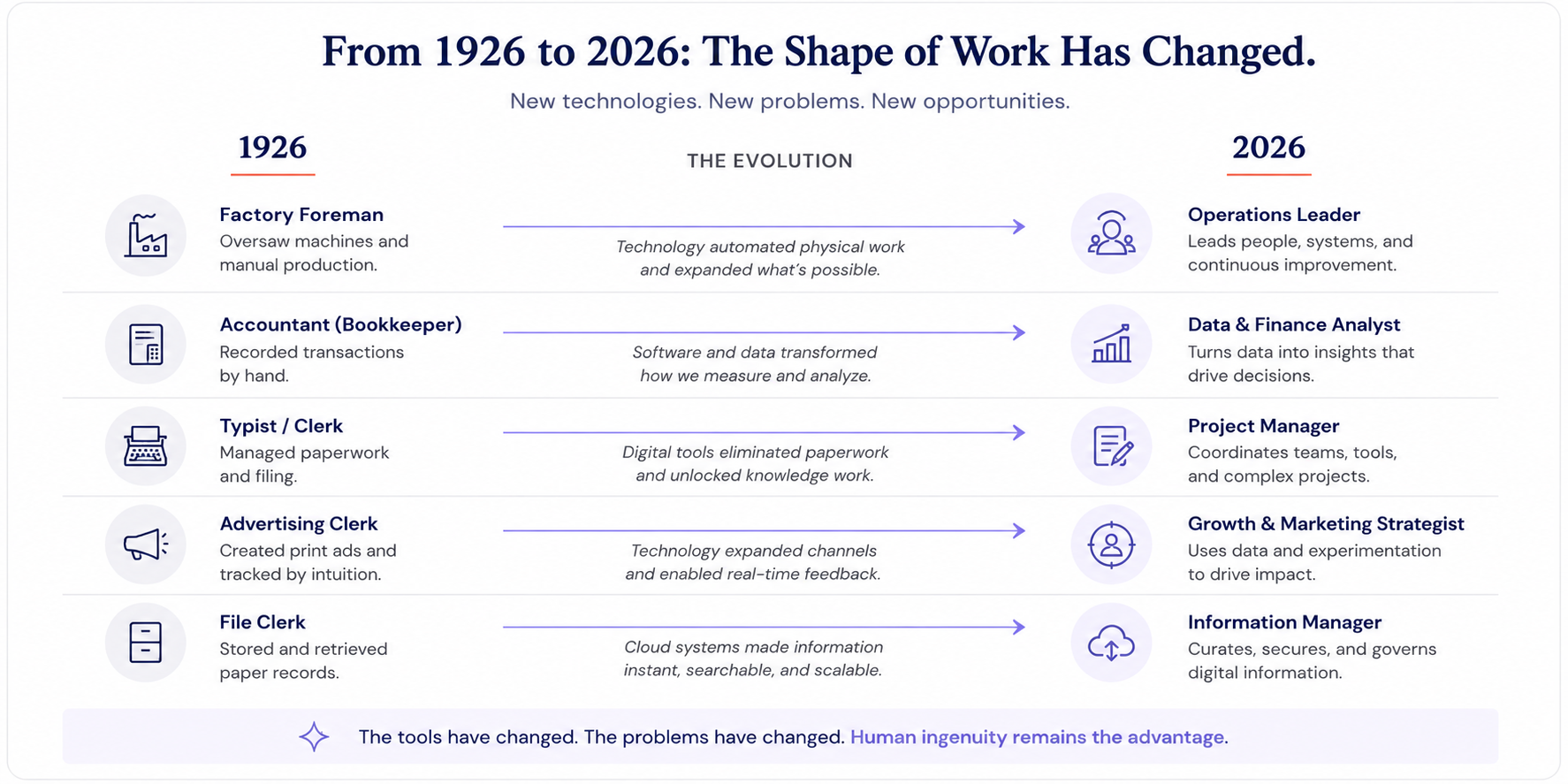
When people talk about AI replacing jobs, I sometimes think we forget how much of modern work would sound completely fictional to someone living one hundred years ago. Software engineers did not exist. Product management did not exist. Project management as a profession barely resembled what it does today. Nobody was becoming a cloud architect or a cybersecurity specialist.
Even professions that did exist evolved dramatically. An accountant today works inside systems and data environments. A marketer studies attribution models and digital journeys. A project manager coordinates distributed teams across time zones using tools that would have sounded impossible in another era. That realization made one of the book’s biggest ideas click for me.
Technology has never eliminated work.
It changes the shape of work.


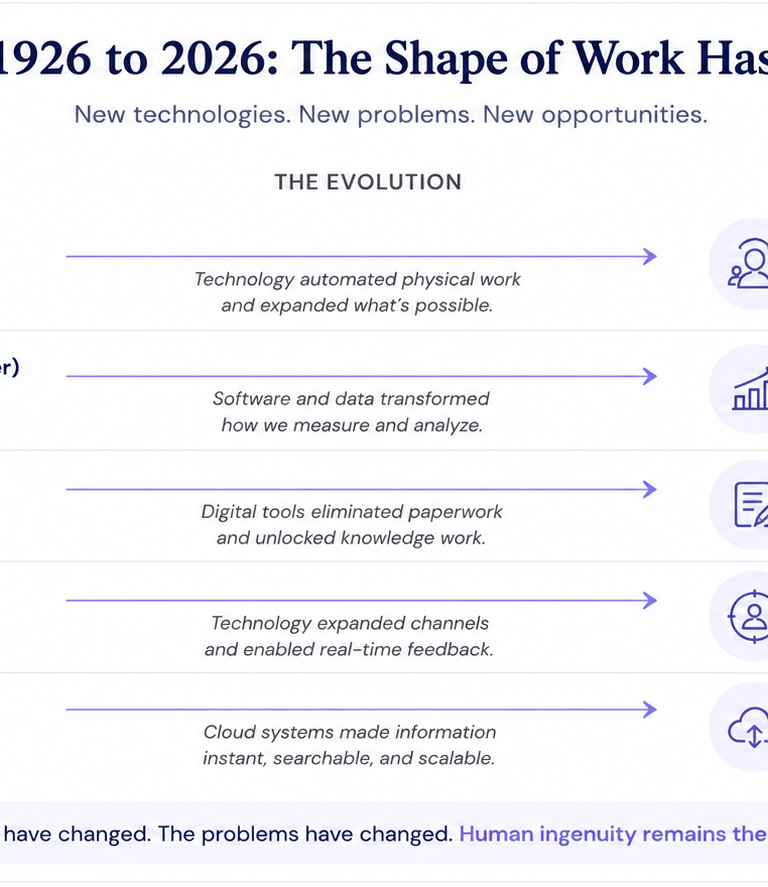
Looking backward actually makes the future feel less frightening. Nobody in 1926 was worried there would someday be too many software engineers because software engineering had not been invented yet. Entire categories of opportunity emerged because technology created new problems to solve.
If change has always created new forms of work, then perhaps adaptation is not something new we suddenly need to learn. Maybe adaptation has always been the job. That perspective felt strangely reassuring.
Déjà Vu? We’ve Been Here Before.
Because if change is the only constant, then learning becomes more valuable than certainty.
That ended up being one of the ideas from The AI-Driven Leader that stayed with me long after I finished the book.
Geoff Woods talks about AI in a way that feels noticeably different from most conversations happening right now. Rather than positioning AI as a replacement for human capability, he frames it as a force multiplier. At first glance that sounds like another piece of technology language. But the more I sat with it, the more I realized how much that distinction matters.
We have seen this pattern before.
The calculator did not eliminate mathematics. Search engines did not eliminate knowledge. Project management software did not eliminate project managers. What those tools actually did was change where humans spent their time.
They reduced repetitive execution and elevated higher-order work. Less time calculating. More time interpreting. Less time collecting information. More time deciding what matters. Less time coordinating manually. More time leading.
Change Has Always Been Part of the Job
What If We Used AI Differently?
That realization started changing how I thought about using AI. If technology has historically shifted human effort upward rather than eliminating it entirely, then maybe the question is not whether AI will replace people. Maybe the more useful question is whether we are using AI in ways that actually make us better. Because if calculators, search engines, and project tools expanded human capability rather than replacing it, then AI may deserve to be evaluated through the same lens.
Most conversations around AI still seem to revolve around outputs. People ask AI to write content, summarize meetings, generate ideas, build presentations, draft emails, and accelerate production. None of those things are inherently wrong. They create efficiency and remove friction from everyday work. But while reading The AI-Driven Leader, I found myself becoming more interested in a completely different possibility.
That shift feels small on the surface, but I think it fundamentally changes the relationship. An output machine gives you answers. A thinking partner helps you discover better questions. And the more I reflected on that distinction, the more I realized how often we accidentally use AI to avoid thinking instead of improving it. We ask for conclusions before we have explored assumptions, ask for polished deliverables before we have pressure tested ideas, and ask for speed before we have earned clarity.
That feels backwards to me because some of the most valuable moments in leadership rarely come from someone giving you the answer. They happen when someone asks a question that forces you to see the problem differently. Good leaders do this. Strong executive sponsors do this. Great architects, business analysts, mentors, and project managers do this naturally. They expand thinking rather than compressing it.
That is where I think AI becomes interesting. Not because it can think for us, but because it can force us to think more deliberately. Instead of asking AI to generate a recommendation, what if we asked it to interview us? Ask me questions about this decision. Challenge my assumptions. Tell me what risks I am overlooking. Act like an executive sponsor reviewing this proposal. Act like a skeptical stakeholder who fundamentally disagrees with me. Pressure test this plan before I present it and force me to defend my reasoning.
That suddenly feels more valuable than producing another first draft. Because sometimes the problem is not that we do not know enough. Sometimes the problem is that we have not forced ourselves to think deeply enough. We move too quickly into execution and mistake momentum for clarity. AI may be most valuable not when it helps us move faster, but when it helps us think longer before committing.
As project managers, I think we already understand this instinctively. Projects rarely fail because nobody had information. Teams usually have data, expertise, options, and access to smart people. What they often do not have is clarity. And clarity rarely appears because somebody worked faster. It usually appears because somebody asked a difficult question earlier than everyone else.
What assumptions are we making? What dependencies are hidden? What are we treating as facts that are actually preferences? Who owns this decision? What happens if we are wrong? Those questions change outcomes because they expose blind spots, create alignment, and force decisions before consequences force them for us.
That may end up being one of the most underrated uses of AI. Not replacing thinking. Improving it. Maybe the real opportunity is not using AI to remove ourselves from the process. Maybe it is using AI to become more intentional participants in it.
What if we stopped treating AI like an output machine - and started treating it like a thinking partner?


AI Is Not the Thought Leader. You Are.


Stay in the Loop
Occasional thoughts on project leadership, Salesforce implementations, books, and the people side of tech.